Skip links

Petrochemicals

Thaioil develops and expands its businesses to add value to petroleum and petrochemical products, serving as a mechanism to drive the country’s economy and continuously enhance the quality of life for its people.

Thai Paraxylene Company Limited

Our Business

A petrochemical plant wholly owned by Thai Oil Plc

Commencement of Commercial Operation

2002

Business Type

Upstream petrochemical business

Capacity

Paraxylene

527,000

Mixed Xylene

52,000

Benzene

259,000

*tons/year

Shareholding Structure

100% owned by Thaioil Public Company Limited

Products

Vel pretium dolor tellus id purus felis tellus cursus. Amet turpis vel enim aliquet maecenas. Egestas nulla urna suspendisse cursus aliquam mauris facilisis.

Petrochemical Business

Aromatic substances are hydrocarbon compounds containing at least six carbon atoms in their molecules, characterized by an aromatic ring structure. Examples include benzene, toluene, paraxylene, and mixed xylenes.

Thai Paraxylene has an annual capacity of 833,000 tons of aromatics products, namely:

Paraxylene527,000tons/year
Benzene259,000tons/year
Mixed Xylenes52,000tons/year

Paraxylene

Paraxylene is an intermediate used in petrochemical plants to produce PTA (Purified Terephthalic Acid). Currently, 65% of PTA is utilized to manufacture polyester fiber, which serves as a raw material for apparel like clothing and fabric bags. Additionally, 30% is used to produce PET (Polyethylene Terephthalate) bottles, commonly used for water and soft drinks, while the remaining 5% is employed in the production of various plastic products, including films, food containers, and heat-resistant plastic bags.

Source: CMA (Spring 24) and TOP’s Estimate

Benzene

Benzene serves as feedstock for intermediate petrochemical plants to make other chemicals including styrene monomer (55%), cumene (22%), and cyclohexane (15%), which are used in the downstream petrochemical industry.

1.Styrene monomer (SM) is used in the manufacture of downstream petrochemical products such as: 

a. Polystyrene (PS), used to make electronic parts (e.g., computers, telephones), toys, furniture, printer ink, adhesives, containers, etc.
b. Acrylonitrile-Butadiene-Styrene (ABS), used to make car parts, suitcases, pipes, LEGO blocks, etc. 
c. Styrene-Butadiene Rubber (SBR), mostly used to make car tires, rubber hoses, rubber bands, etc. 
d. Expanded Polystyrene (EPS), mostly used in construction, baby diapers, artificial snow, etc. 

2.Cumene is feedstock of phenol and acetone, which are used as a precursors of polycarbonate (PC), found in the construction business such as roofing, as well as in lenses, CDs, and touch screens.

3.Cyclohexane yields caprolactam, which is feedstock of nylon 6, found in synthetic fiber (in sportswear, tent fabric, etc.) and molded plastic beads, among others.

Source: CMA (Spring 24) and TOP’s Estimate

Toluene

Toluene usually undergoes different processes to make benzene and mixed xylenes. It can also be combined with gasoline to boost octane values and can be used as a solvent for coating substances, insecticides, paint, adhesives, etc.

Mixed Xylenes

Mixed xylenes are feedstock of paraxylene. It can also be used to boost octane values in gasoline, as well as a solvent for coating substances, insecticides, paint, adhesives, etc.

Production Process

The products obtained from the manufacturing process of Thai Paraxylene Company Limited include paraxylene, mixed xylene, benzene, and toluene.

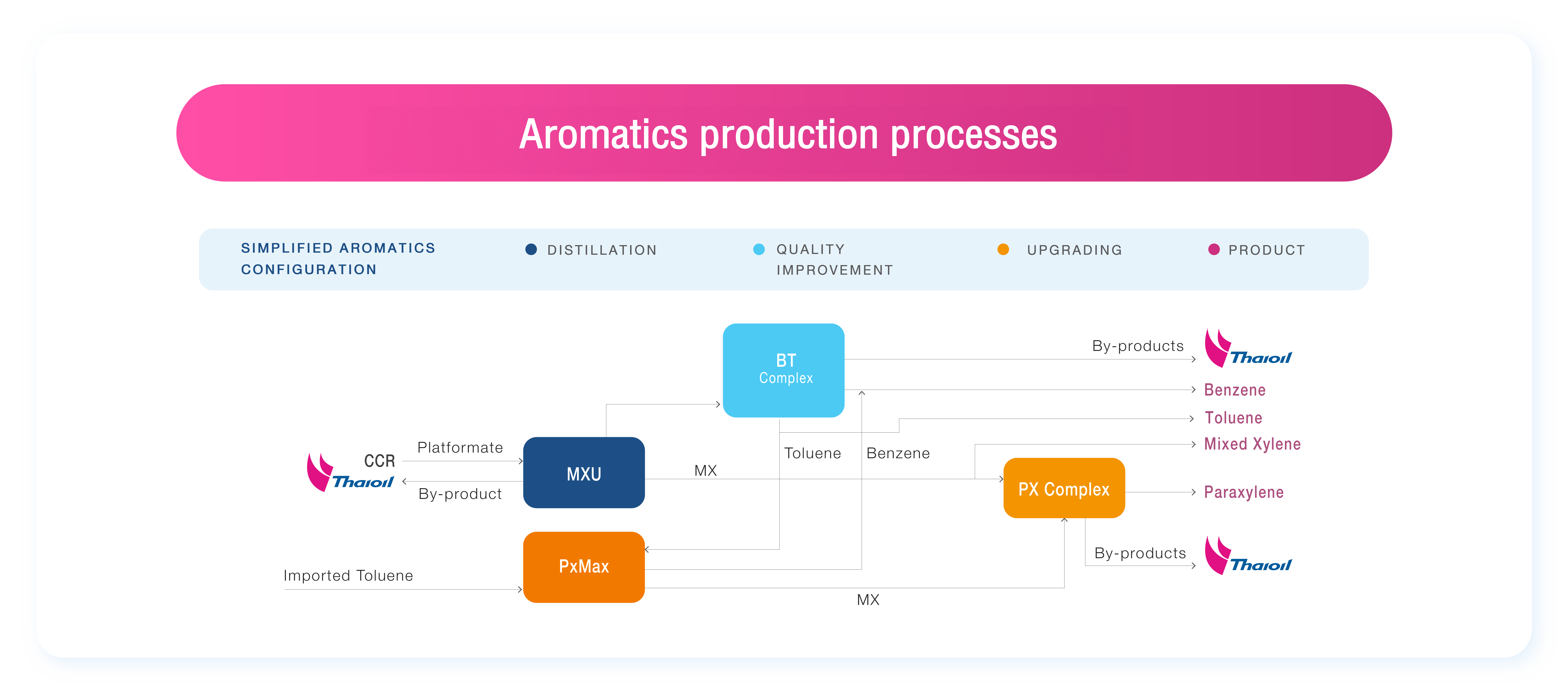
Aromatics production processes

The Mixed Xylene Unit (MXU)

The Mixed Xylene Unit (MXU)

Platformate from the Continuous Catalyst Regeneration Platformer Unit in ThaiOil refinery is distillated into C5 Product (Light hydrocarbon), Crude Benzene (Low purity benzene), Crude Toluene (low purity toluene), Mixed Xylene, and C9+ (Heavy product).

C5 Product, Crude Toluene, and C9+ are send back to ThaiOil refinery for gasoline blending.

For Crude Benzene, it is used as feedstock of aromatic separation process (BT Complex) for high purity benzene and toluene production.

Finally, Mixed Xylene unit (MXU) also produces mixed xylene which consists of ethylbenzene, paraxylene, metaxylene, and orthoxylene for either selling to customer directly or feeding PX production unit (PX Complex).

The Paraxylene (PX) production unit

The Paraxylene (PX) production unit consists of three subunits. Mixed Xylene (MX) from the MX unit is fed into the Parex unit to separate paraxylene from other xylene compounds through an adsorption process. The resulting paraxylene is then distilled to achieve a purity of up to 99.7% by weight. The remaining xylene compounds, referred to as the raffinate stream, include ortho-xylene, meta-xylene, and ethylbenzene. These are sent to the Isomar unit, where ortho-xylene and meta-xylene are converted into paraxylene through isomerization, while ethylbenzene is transformed into benzene via the EB dealkylation reaction, resulting in increased production of both paraxylene and benzene by-products.

Additionally, the Xylene Rerun Unit separates heavy aromatics (C9+) from light aromatics (C8) in the mixed xylene, preparing it for the Parex unit. Some C9+ aromatics from the MX unit are processed in the Xylene Rerun Unit to isolate A9, which is then returned to Thai Oil Public Company Limited for gasoline blending. The remaining heavy components, known as “Heavies,” are also sent back to Thai Oil Public Company Limited for fuel oil blending.

The Separation Unit

The Separation Unit for Aromatics and Non-Aromatics (ED Sulfolane) receives crude benzene from the MX unit and benzene from the Isomar unit to extract non-aromatic compounds using a solvent. The extracted non-aromatic compounds are then sent back to Thaioil Public Company Limited for use in gasoline blending. Meanwhile, the remaining aromatic compounds are sent to the Benzene and Toluene Separation Unit (BTF-1) for further processing.

The Benzene & Toluene Fractionation 1 (BTF-I) unit

The Benzene & Toluene Fractionation 1 (BTF-1) unit receives aromatic compounds from the ED Sulfolane unit to separate benzene, toluene, and xylene, resulting in high-purity benzene and toluene for distribution to customers. Additionally, toluene can be sent to the PxMax unit for further production of paraxylene and benzene. Any remaining xylene is directed to the Xylene Rerun Unit for further processing.

The PxMax unit

The PxMax unit employs specialized technology designed to enhance the value of toluene by converting it into high-value paraxylene and benzene, which are key feedstocks for the petrochemical industry. Toluene entering the PxMax unit undergoes Selective Toluene Disproportionation (STDP) using specially structured molecular sieve catalysts to produce a xylene mixture rich in high-purity paraxylene and co-produced benzene. This technology allows the PxMax unit to generate xylene mixtures in high proportions while producing minimal gas byproducts. The byproduct gas is utilized as fuel within the complex, while the remaining xylene, benzene, and toluene are routed to the Benzene & Toluene Fractionation 2 Unit (BTF-II) for further processing.

The Benzene & Toluene Fractionation Unit 2

The Benzene & Toluene Fractionation Unit 2 (BTF-II) receives the remaining mixed xylenes, benzene, and toluene from the PxMax unit for further fractionation. In this unit, benzene is purified to a sufficient degree for distribution to customers. The mixed xylene with a high paraxylene content is sent to the Parex unit to separate high-purity paraxylene for subsequent distribution. Finally, the remaining toluene is recycled back to the PxMax unit for further reactions.

General Information

Acronym

TPX

Registration Number

0105539103288

Business Type

Upstream petrochemical business

Registered Capital (Baht)

2,572,414,160 Baht

Type of Share

Common

Number of Share (Sold)

257,241,416

Value of Share (Baht/Share)

10 Baht

Contact Us

Thai Paraxylene Company Limited

Address

105/12 Moo 2 Sukhumvit Road Tungsukla, Sriracha, Chonburi 20230

Contact

0 – 3835 – 1317-9, 0 – 3835 – 1878

0 – 3835 – 1320

LABIX Company Limited

Our Business

The first integrated LAB producer in South East Asia with the most advanced technology.

Commencement of Commercial Operation

2016

Business Type

Manufacturing of LAB

Capacity

LAB

120,000

*tons/year

Shareholding Structure

Thai Paraxylene Company Limited

75%

Mitsui & Co., Ltd.

25%

Products

Vel pretium dolor tellus id purus felis tellus cursus. Amet turpis vel enim aliquet maecenas. Egestas nulla urna suspendisse cursus aliquam mauris facilisis.

Linear Alkyl Benzene (LAB)

LAB is an intermediate in production of Linear Alkylbenzene Sulfonates (LAS) which is anionic surfactant; used in detergent business. Most of LAB is converted into LAS and used in the production of detergent in household. The remaining is utilized for cleaning in industrial and commercial applications.

LAB/LAS is used for feedstock of :

  • Powder detergents
  • Liquid detergents
  • Dishwashing liquids
  • Liquid household cleaners
  • Emulsion polymerization
  • Emulsifiers

Heavy Alkyl Benzene (HAB)

HAB is by-product of LAB process. HAB has applications in:

  • Heat transfer oil
  • Enhanced oil recovery
  • Lubricant additives

Molex Raffinates

Molex raffinates, which are by-products of the preparation process for normal paraffin, find applications in:

  • Solvent in paint industry
  • Solvent in Mining industry

Production Process

Vel pretium dolor tellus id purus felis tellus cursus. Amet turpis vel enim aliquet maecenas. Egestas nulla urna suspendisse cursus aliquam mauris facilisis.

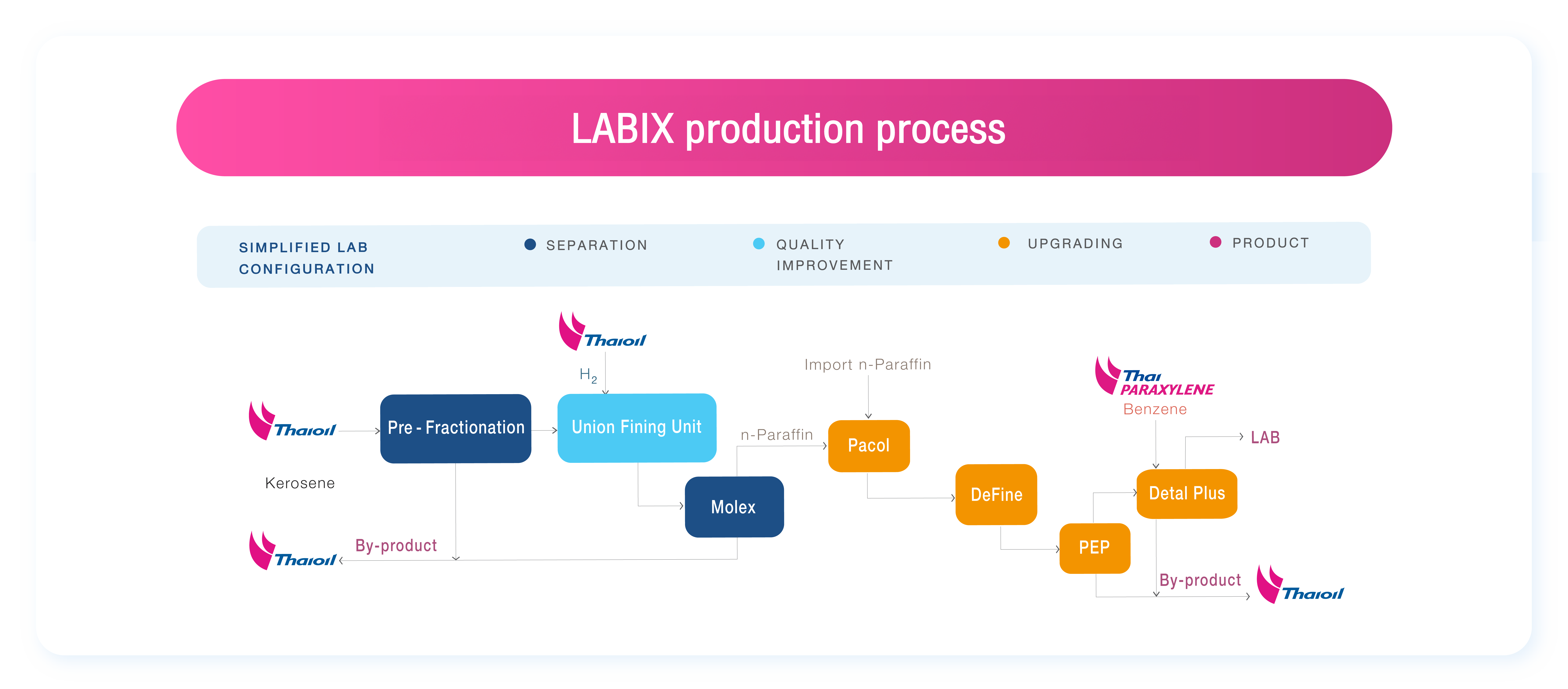
LABIX production process

The production process of Linear Alkyl Benzene (LAB)

The production process of Linear Alkyl Benzene (LAB) utilizes technology from Universal Oil Product Company Limited (UOP), located in the United States of America, renowned for its leadership in oil refining and petrochemical industries. Within the LAB production unit, there are two main divisions: the initial substance preparation unit and the LAB production unit.

The initial substance preparation unit, namely n-Paraffin
The initial substance preparation unit, namely n-Paraffin, consists of three subunits: Kerosene Prefractionation Unit: This unit distills kerosene received from Thai Oil Company, which is a hydrocarbon compound between C9 – C14+ with a boiling point between 150 – 250 degrees Celsius. Through distillation, a particular range of hydrocarbons within the C10 to C13 range are separated from the kerosene by this unit and then forwarded to the next subunit. UOP Unionfining Process: This unit removes impurities such as nitrogen, sulfur, and oxygen through hydrotreating to enhance quality, then forwards the product to the next subunit. UOP Molex Process: This unit further separates straight-chain hydrocarbon structures within the C10 – C13 range from other molecular shapes, resulting in high-purity n-Paraffin for subsequent LAB production. Regarding the hydrocarbon compounds lighter than C10 (Light Kerosene), heavier than C13 (Heavy Kerosene), and other non-straight-chain hydrocarbon structures (Molex Raffinate), they are combined and returned to Thai Oil Company Limited (Public) as by-products for aviation fuel blending. Some portions of Molex Raffinate are exported to customers both domestically and internationally.
The LAB production unit
The LAB production unit comprises three subunits: UOP Pacol & Define Process Unit: The UOP Pacol unit converts a portion of n-Paraffin into olefins (mono-olefin and di-olefin) through dehydrogenation. The by-product from this unit is hydrogen. Most di-olefins are further converted into mono-olefins by the UOP Define Process unit through hydrogenation to increase mono-olefin content. The product stream, which is enriched in mono-olefin, will be forwarded to the next subunit, the UOP PEP Process unit. UOP PEP Process Unit: This unit separates heavier aromatic hydrocarbon molecules (by-products) to increase the quality of the stream and meet the specification of the next subunit, the Detal-Plus process unit. Detal-Plus Process Unit: This unit facilitates an alkylation reaction between mono-olefins and benzene to produce linear alkyl benzene (LAB) as the main product. The by-product obtained from this process is heavy alkyl benzene (HAB).
History

Vel pretium dolor tellus id purus felis tellus cursus. Amet turpis vel enim aliquet maecenas. Egestas nulla urna suspendisse cursus aliquam mauris facilisis.

Ever since its establishment in 1961, Thaioil Group has been committed to the petroleum and petrochemical businesses, utilizing sophisticated, efficient, and eco-friendly technology while focusing on integrated group management to enhance connectivity among affiliates.

Thai Paraxylene Co., Ltd. (TPX) was conceived as a producer of petrochemicals, namely paraxylene, benzene, and toluene. Steady progress has been made at TPX, with enhancements in process capability aimed at growing its business and expanding its product range to meet consumers’ needs for everyday products.

Founded in 1947, Mitsui & Co. a world-class trading company. Throughout its long history, Mitsui has spearheaded innovations to keep pace with global growth while expanding its business into multiple industrial sectors related to the chemical and energy industries, as well as consumer goods. It boasts a worldwide commercial network. As one of the world’s largest distributors of LAB, Mitsui is also experienced and proficient in LAB marketing.

Together, Thaioil Group (through TPX) and Mitsui & Co. have scaled up the business of pioneering LAB production, which is the most fully integrated in Thailand and Southeast Asia. They formed LABIX Co., Ltd. in 2013 as Thailand’s petrochemical producer of LAB, an essential feedstock for detergents and cleaning agents, by leveraging advanced and eco-friendly technology.

LABIX is Thailand’s first and only producer of LAB, with a capacity that can satisfy all domestic demand and export surplus capacity to markets abroad. Located in Si Racha, Chon Buri, the company is positioned roughly in the center of Thailand, making it logistically ready for product transport by both sea and land. In other words, LABIX has logistical advantages for efficient transport to domestic and international customers.

General Information

Acronym

LABIX

Registration Number

0105556110246

Business Type

Manufacturing of LAB

Registered Capital (Baht)

4,654,965,000 Baht

Type of Share

Common

Value of Share (Baht/Share)

10 Baht

Contact Us

LABIX Company Limited

Lorem Ipsum is simply dummy text of the printing and typesetting industry. Lorem Ipsum is simply dummy text of the printing and typesetting industry. Lorem Ipsum is simply dummy text of the printing and typesetting industry.

Head Office

555/1 Energy Complex Building A, 11th Floor Vibhavadi Rangsit Road, Chatuchak, Chatuchak, Bangkok 10900

0 – 2797 – 2999, 0 – 2797 – 2900

0 – 2299 – 0000

Site Office

105/13 Moo 2, Sukhumvit Road, Tungsukla, Sriracha, Chonburi 20230

038 - 408 - 500

038 - 359 - 019

PT Chandra Asri Pacific Tbk

Our Business

Chandra Asri Group is Indonesia’s leading chemical and infrastructure solutions company, operating an integrated petrochemical plant that incorporates world-class, state-of-the-art technology and supporting facilities. CAP operates Indonesia’s only naphtha cracker, styrene monomer, butadiene, MTBE, and butene-1 plants, supported by core infrastructure assets encompassing energy, water, and jetty and tank facilities, with new chlor-alkali and ethylene dichloride plant developments on the horizon.

Commencement of Commercial Operation

1992

Business Type

Petrochemicals and
Infrastructure Solutions

Capacity

Ethylene

900,000

Propylene

490,000

*tons/year

Shareholding Structure

15% by Thai Oil Public Company Limited through its subsidiary in Indonesia, PT TOP Investment Indonesia

Products

Vel pretium dolor tellus id purus felis tellus cursus. Amet turpis vel enim aliquet maecenas. Egestas nulla urna suspendisse cursus aliquam mauris facilisis.

POLYOLEFINS

POLYETHYLENE

Our polyethylene resin is sold under the trademark “Asrene®,” which covers high-density polyethylene (HDPE) and linear low-density polyethylene (LLDPE) products. We also produce resin for environmentally friendly shopping bags under the trademark “Grene®.” Grene shopping bags decompose naturally in the presence of ultraviolet light. Other end-product applications include agricultural film, flexible packaging, fishnets, tarpaulin, clean water pipes, jerry cans, and cosmetics and food-grade bottles.

POLYPROPYLENE

Our polypropylene resin is sold under the trademark “Trilene®,” which includes various types of homopolymer, random copolymer, and impact (block) copolymer. Some end-product applications include flexible packaging (IPP, BOPP, CPP), household appliances, yarn, non-woven bags, furniture, and automotive and electronic parts.

The Company’s polyethylene and polypropylene products are certified Halal by Majelis Ulama Indonesia (MUI).

STYRENE MONOMER

Styrene monomer is a raw material used to produce polystyrene (PS), expanded polystyrene (EPS), styrene acrylonitrile (SAN), acrylonitrile butadiene styrene (ABS), styrene butadiene rubber (SBR), styrene butadiene latex (SBL), and unsaturated polyester resin (UPR). Some end-product applications include shoe soles, drinking cups, food containers, automotive and electronic parts, building block toys, and helmets.

BUTADIENE

Butadiene is a raw material used in the production of ABS, SBL, SBR, and polybutadiene rubber (PBR), which are key components in tire manufacturing. Some end-product applications include rubber boots, rubber gloves, shoe soles, adhesives, and sealants.

OLEFINS

All olefin products (ethylene, propylene) and their by-products (py-gas, mixed C4, and PFO) are produced from the naphtha cracker plant. Chandra Asri mainly distributes ethylene and propylene via pipeline to its key customers and ships py-gas and PFO to other customers. The mixed C4 is fully utilized as raw material for its butadiene plant.

กระบวนการผลิต บริษัท ลาบิกซ์ จำกัด

กระบวนการกลั่นน้ำมัน คือ กระบวนการการแยกโมเลกุลสารไฮโดรคาร์บอนที่อยู่ใน น้ำมันดิบและแปรสภาพสสารดังกล่าวให้เป็นผลิตภัณฑ์ปิโตรเลียมสำเร็จรูปที่มีมูลค่าสูงกว่า

กระบวนการผลิต

กระบวนการผลิตสาร Linear Alkyl Benzene (LAB)

กระบวนการผลิตสาร Linear Alkyl Benzene (LAB) ใช้เทคโนโลยีการผลิตที่ทันสมัยที่สุดจาก Universal Oil Product Company Limited (UOP) ประเทศสหรัฐอเมริกา ซึ่งเป็นผู้นำด้านเทคโนโลยีเกี่ยวกับโรงกลั่นน้ำมันและอุตสาหกรรมปิโตรเคมี ซึ่งในหน่วยผลิตสาร LAB สามารถแบ่งออกเป็น 2 หน่วยใหญ่ คือ หน่วยการเตรียมสารตั้งต้น นอร์มอลพาราฟิน (n – Paraffin) และหน่วยผลิตสาร Linear Alkyl Benzene (LAB)

หน่วยการเตรียมสารตั้งต้น n - Paraffin

หน่วยการเตรียมสารตั้งต้น n – Paraffin ประกอบด้วยหน่วยผลิตย่อย 3 หน่วย ได้แก่
(1) หน่วย Kerosene Prefractionation ทำหน้าที่กลั่นแยกน้ำมันเคโรซีน (Kerosene) ที่ถูกส่งมาจากบริษัทไทยออยล์ ซึ่งเป็นสารประกอบไฮโดรคาร์บอนระหว่าง C9 – C14+ ที่มีจุดเดือดระหว่าง 150 – 250 องศาเซลเซียส โดยการใช้หอกลั่นแยกสารประกอบไฮโดรคาร์บอนตามจุดเดือด เพื่อแยกไฮโดรคาร์บอนที่มีขนาดความยาวโมเลกุลอยู่ในช่วง C10 – C13 ออกมาจากน้ำมันเคโรซีน จากนั้นจึงนำส่งเข้าสู่หน่วยย่อยที่
(2) UOP Union fining Process ซึ่งทำหน้าที่กำจัดสารปนเปื้อนประเภทกำมะถัน ไนโตรเจนและออกซิเจน ด้วยกระบวนการ Hydrotreating เพื่อปรับปรุงคุณภาพ และขั้นตอนสุดท้าย คือ การส่งสารประกอบไฮโดรคาร์บอนดังกล่าวเข้าสู่หน่วยผลิตย่อยที่
(3) UOP Molex Process ซึ่งทำหน้าที่แยกโครงสร้างของสารประกอบไฮโดรคาร์บอนแบบโซ่ตรง (straight chain) ที่มีความยาวโมเลกุลระหว่าง C10 – C13 ออกจากโมเลกุลรูปร่างอื่นๆ ซึ่งจะได้น้ำมัน n – Paraffin (Normal Paraffin) ที่มีความบริสุทธิ์สูง เพื่อใช้ในการผลิตสาร LAB ต่อไป สำหรับสารประกอบไฮโดรคาร์บอนที่มีขนาดโมเลกุลเบากว่า C10 (Light Kerosene), ไฮโดรคอร์บอนที่หนักกว่า C13 (Heavy Kerosene) และไฮโดรคาร์บอนโครงสร้างอื่นที่ไม่ใช่โครงสร้างแบบโซ่ตรง (Molex Raffinate) จะถูกรวมกันและส่งกลับบริษัท ไทยออยล์ จำกัด (มหาชน) เป็นผลิตภัณฑ์พลอยได้ เพื่อใช้เป็นส่วนผสมของน้ำมันอากาศยานต่อไป และมี Molex Raffinate บางส่วนส่งออกขายให้กับลูกค้าทั้งในและต่างประเทศ

หน่วยผลิตสาร LAB

หน่วยผลิตสาร LAB ประกอบด้วยหน่วยผลิตย่อย 3 หน่วย ได้แก่ (1) หน่วย UOP Pacol & Define Process โดยหน่วย UOP Pacol จะทำหน้าที่เปลี่ยน n – Paraffin บางส่วนให้เป็นสารโอเลฟินส์ (mono-Olefin และ di-Olefin) ด้วยปฏิกิริยา Dehydrogenation โดยมีผลิตภัณฑ์พลอยได้ คือ ไฮโดรเจน ซึ่ง di-Olefin จะถูกหน่วยผลิตย่อย UOP DeFine Process เปลี่ยนให้เป็น mono – Olefins ต่อ ด้วยปฏิกิริยา Hydrogenation เพื่อเพิ่มปริมาณของ mono – Olefins ให้มากขึ้น ก่อนจะถูกส่งต่อไปเข้าหน่วยผลิตย่อยที่ (2) UOP PEP Process ที่มีหน้าที่แยกไฮโดรคาร์บอนโมเลกุลที่มีน้ำหนักมากออก เพื่อเพิ่มความบริสุทธิ์ให้ได้คุณภาพที่เหมาะสมกับหน่วยผลิตถัดไป โดยจะได้ผลิตภัณฑ์พลอยได้ คือสารอะโรเมติกส์หนัก (PEP Aromatics) จากนั้น n-paraffin และ mono- Olefins จะถูกส่งต่อไปยังหน่วยผลิตย่อยที่ (3) Detal – Plus Process ซึ่งมีหน้าที่ในการทำปฏิกิริยายา Alkylation ระหว่าง mono – Olefins และสารเบนซีนบริสุทธิ์ เพื่อผลิต เพื่อผลิตสาร Linear Alkyl Benzene (LAB) เป็นผลิตภัณฑ์หลัก โดยมีผลิตภัณฑ์ผลพลอยได้ คือ Heavy Alkyl Benzene (HAB)

General Information

Vel pretium dolor tellus id purus felis tellus cursus. Amet turpis vel enim aliquet maecenas. Egestas nulla urna suspendisse cursus aliquam mauris facilisis.Vel pretium dolor tellus id purus felis tellus cursus.

Acronym

CAP

Registration Number

-

Business Type

Upstream Petrochemicals

Registered Capital (Baht)

12,264,785,664,000 IDR

Value of Share (Baht/Share)

-

Contact Us

Chandra Asri

Head Office

Wisma Barito Pacific Tower A, 7th Floor

Jl. Let. Jend. S. Parman Kav. 62 - 63 Jakarta 11410, Indonesia

(62-21) 530 7950

(62-21) 530 8930

Site Office

Chandra Asri Plant, Puloampel Site

Desa Mangunreja Puloampel, Serang Banten 42456, Indonesia

(62-254) 575 0080

(62-254) 575 0085

Site Office

Chandra Asri Plant, Ciwandan Site

Jl. Raya Anyer Km. 123 Ciwandan, Cilegon Banten 42447, Indonesia

(62-254) 601 501

(62-254) 601 838 / 843